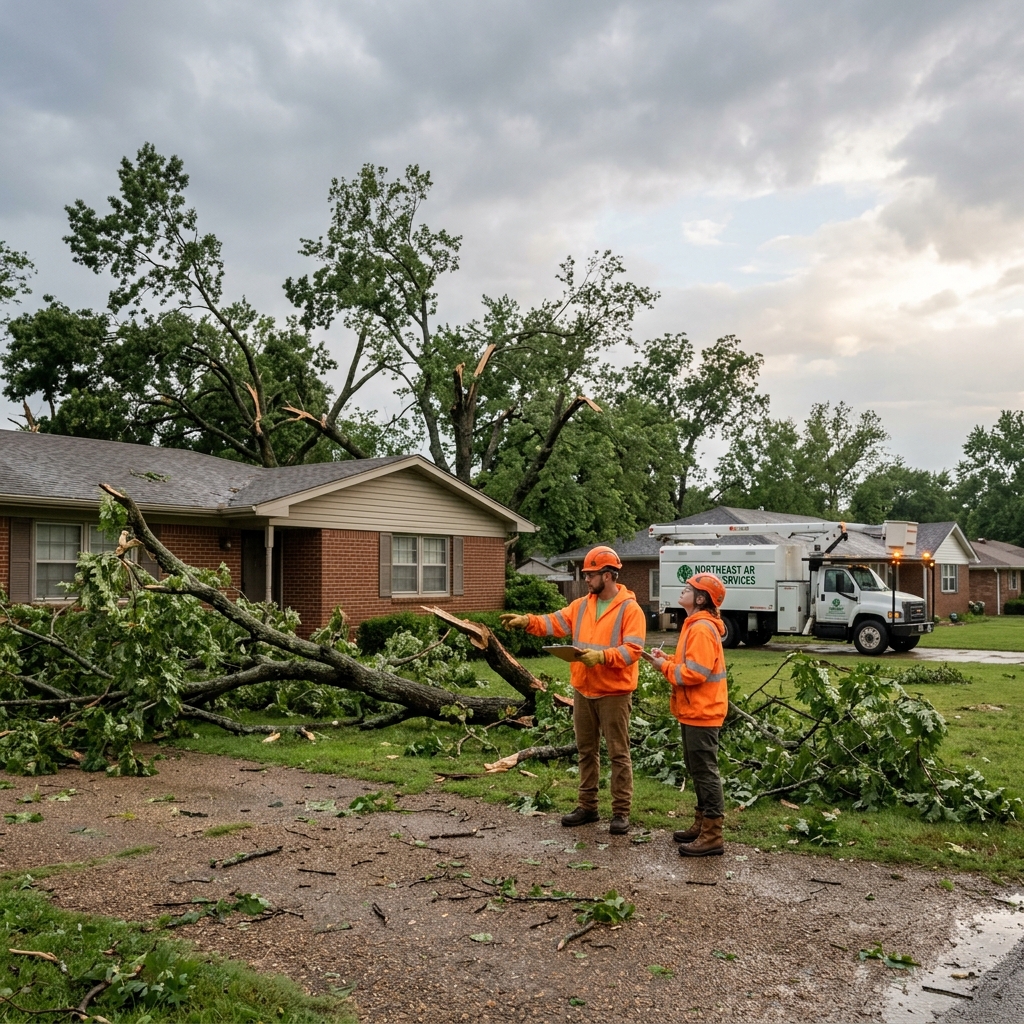
Northeast Arkansas gets serious weather. Thunderstorm season runs from spring through early fall and brings straight-line winds, hail, lightning, and heavy rain that tests every tree on your property. A significant portion of storm-related tree damage is preventable through targeted maintenance done before the season begins.
Our Jonesboro-based tree care team also provides storm-damage cleanup throughout Northeast Arkansas service communities.
Start with a Structural Assessment
Before spending money on any pruning or treatment, walk your property and look at each significant tree with fresh eyes. What you are looking for:
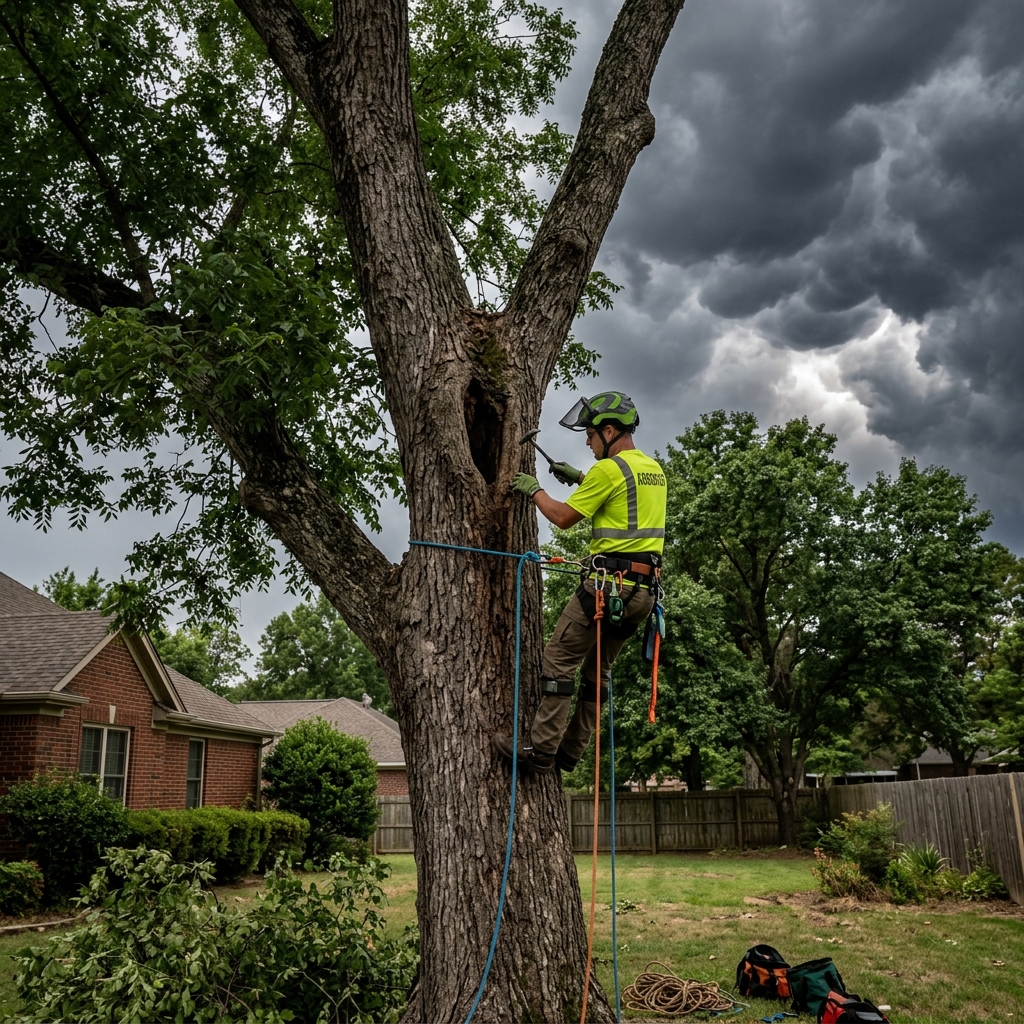
- Co-dominant stems: Two or more main trunks growing from the same point with included bark compressed between the stems. This is a common failure point under wind load.
- Existing cracks or splits: Any visible splitting in major crotches or along the trunk indicates structural weakness that will not improve on its own.
- Canopy imbalance: Trees with significantly heavier crown development on one side are more susceptible to wind failure in that direction.
- Root zone issues: Soil heaving, exposed roots on the uphill side, or previous ground disturbance near the root zone can indicate root instability.
Trees with structural defects need professional evaluation, not just trimming. Some can be stabilized with corrective pruning or cabling. Others have reached the point where removal before storm season is the responsible call.
Remove Deadwood from the Canopy
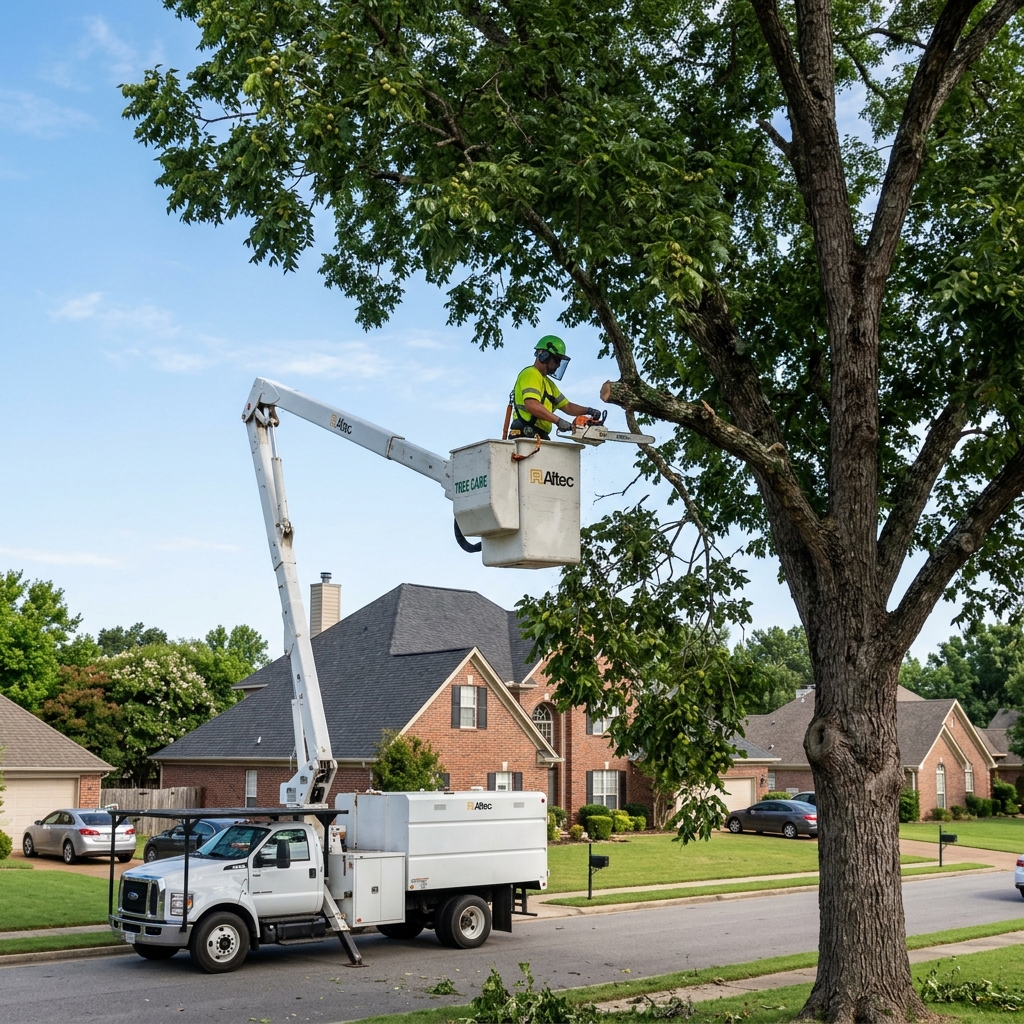
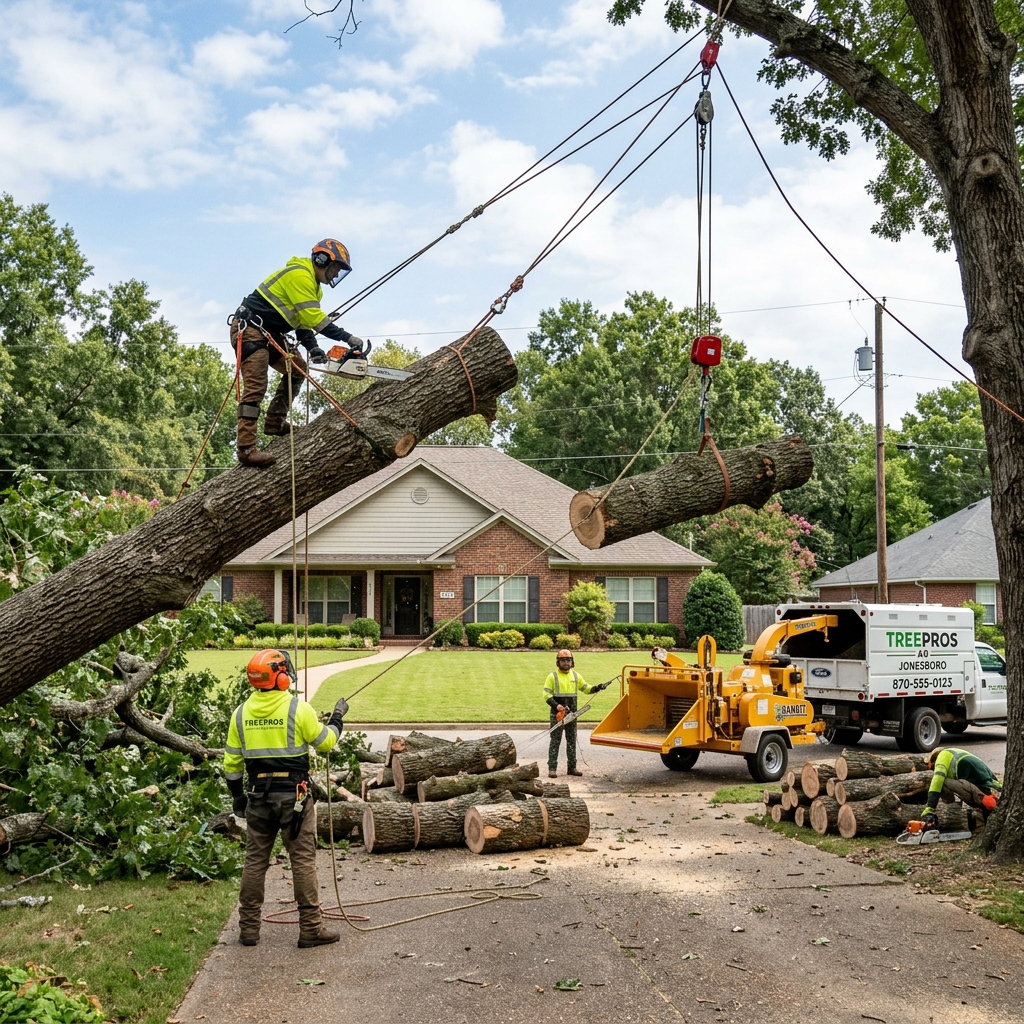
This is the single most effective pre-storm action for most Jonesboro residential properties. Deadwood in the canopy will come down in a storm. Deadwood removal by a trained crew can clear accumulated dead branches from multiple trees in a single visit. Focus first on deadwood over occupied areas, structures, vehicles, and walkways. Secondary priority is deadwood over fences, neighbor property lines, and utility lines.
Address Canopy Weight and Wind Resistance
Dense, unpruned canopies create significant wind resistance. Crown thinning selectively removes interior branches to reduce density without eliminating the tree's structure, reducing the sail effect during high-wind events. For professional trimming for healthier growth, the target is a canopy that allows wind to pass through it while maintaining the natural branching structure that gives the tree its strength. This is not the same as topping, which consistently makes trees more dangerous.
Clear Branches from Structures and Utilities
Branches that are already close to or in contact with a structure become more aggressive under wind load. A branch that barely clears the roofline in still conditions can cause significant damage in a 60 mph wind event. Pre-storm clearance trimming to establish working distance between canopy edges and your roof, gutters, siding, and utility connections is maintenance that pays for itself quickly.
Evaluate Trees Near Structures for Risk
Trees that show multiple risk factors—structural defects, deadwood accumulation, root instability, and proximity to occupied spaces—should be evaluated professionally before storm season. For trees that are questionable but not clearly at the removal point, after-hours help with tree hazards is available if the tree fails during a storm. But having the assessment done before storm season gives you options that emergency response does not.
Understand What You Cannot Control
Even well-maintained trees can fail in extreme weather. The goal of pre-storm maintenance is risk reduction, not risk elimination. What preventive maintenance does is remove the trees and limbs most likely to fail under normal severe weather conditions—the ones that would have come down in the first significant storm anyway.
Pre-Storm Tree Assessment for Your Jonesboro Property
We provide pre-season tree assessments and maintenance throughout Jonesboro, Brookland, Paragould, and surrounding communities. Written estimates, experienced crew.
Frequently Asked Questions
Late winter through early spring, before new leaf growth emerges, is ideal for structural assessment and pruning. This gives you visibility into the branch structure before foliage obscures it and allows wounds to begin compartmentalizing before the active growing season. However, storm prep can be done anytime a hazard is identified.
No. Topping removes the natural branch structure that gives a tree its wind resistance, creates large open wounds that invite decay, and generates multiple weakly attached water sprouts that are more susceptible to wind failure than the original branches. Topping consistently makes trees more dangerous, not less.
Included bark occurs when bark becomes compressed between two co-dominant stems or branches as they grow. Instead of forming a strong wood union, the stems are held together by bark, which is a much weaker bond than wood. Under wind or ice load, included bark unions are a common point of stem splitting.
In some cases, yes. Professional cabling systems can supplement the structural support of a tree with a co-dominant stem or other identifiable weakness, reducing the risk of failure under storm load. However, cabling is not appropriate for every structural defect and should be installed by a trained professional.
Not necessarily. A tree with no visible defects, healthy root attachment, appropriate clearance from structures, and a stable growth history does not need to be removed as storm prep. Pre-storm maintenance is about identifying and addressing actual risk factors, not removing trees out of general caution.
Bottom Line
Pre-storm tree maintenance in Northeast Arkansas is one of the most practical investments a Jonesboro property owner can make. Removing deadwood, addressing structural defects, and establishing clearance from structures consistently reduces damage during storm events and lowers the cost of post-storm cleanup. For trusted arborist services in Jonesboro before storm season, schedule an on-site assessment and get a written estimate for any work that needs to be done.